The Art of Disagreeing
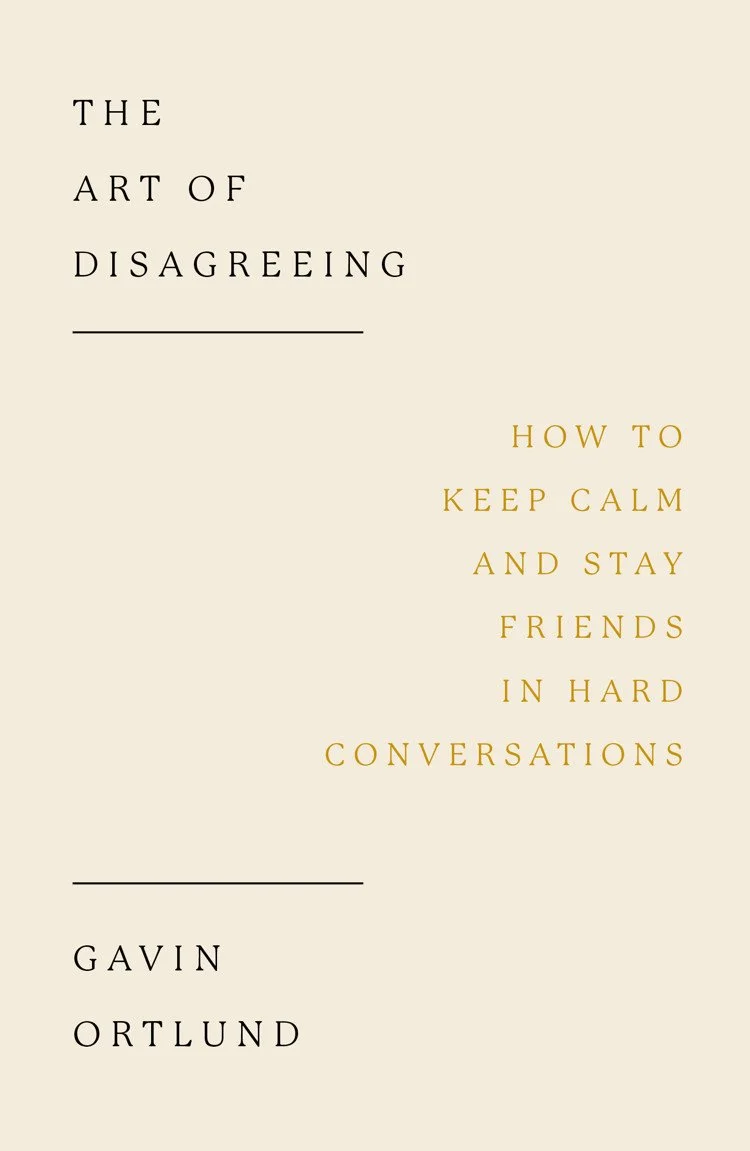
The Art of Disagreeing: How to Keep Calm and Stay Friends in Hard Conversations
By: Gavin Ortlund
“Can you imagine how the church might be changed and the world might be impacted if we conducted our disagreements with the love of Christ?”
The world would be a better place if everyone read this book. And not because it would magically make everyone agree with each other— it’s not trying to do that.
People are going to disagree— that’s reality and because of the nature of truth, it can’t be avoided. People are going to disagree about what is true. So how do we handle disagreements and maintain our friendships?
This short book (under 100 pages) does a great job of providing practical guidance to that end.
The chapter titles are the principles Ortlund advises: Kindness, Courage, Listening, Persuasion, and Love.
Throughout the book, Ortlund is careful in describing each principle and recognizing the common pitfalls we may be tempted by. For example, kindness is not at odds with discernment and conviction; courage does not see every disagreement as a battlefield.
Ortlund refers to a social psychology theory about two contrasting ways people deal with disagreements. They can be rhinos or hedgehogs. Rhinos are aggressive and charging. Hedgehogs are defensive and shield themselves. Neither is helpful. Rhinos need to exercise restraint and hedgehogs need to find more courage.
Ortlund posits that we need both kindness and courage to have healthy agreements.
“Kindness without courage is too flimsy; courage without kindness is too brash.”
We can stand for truth with both kindness and courage— but only with the right focus:
“When we look to Jesus, his kindness and courage flow into us, enabling us to speak the truth courageously but to do so with love in our hearts.”
I think a lot of people assume that to show love in a disagreement means we give in or we wave the disagreement away as if it doesn’t matter. Truth matters. This book is not questioning the ‘what’ (truth) but the ‘how’ (our conduct and heart) of our disagreements.
I thought it was important how he talks about the sincerity of the kindness.
“When we sincerely wish others well, it comes across. People can tell. Similarly, when what is in your heart toward someone is contempt and a ‘rolling of the eyes’ attitude, this also will come across… They can feel either our respect or our disdain.”
We need to come to a place where we can sincerely wish them well and care about them as people, even if we disagree with them. A couple things he recommends to help with that is to first pray blessings for them and for ourselves that we would see their dignity and complexity as a human being made in the image of God.
Other practical advice is to not talk ill of them behind their back and to consider how their experiences have shaped their perspective. While lived experience is not an authority on truth, it does help us to understand where other people are coming from.
Kindness is the commitment to the person. And this needs the proper balance of courage, which is commitment to the truth.
Gavin Ortlund also wrote the book Finding the Right Hills to Die On: The Case for Theological Triage that I found helpful when considering where to place our courage, how to pick our battles, the right hills.
Our culture doesn’t always do a great job of showing real courage. Ortlund points out false ‘macho’ courage that lacks vulnerability. Courageous acts, he says, are often done in the quiet, private moments of decision making.
“Part of the reason courage feels vulnerable is that it is often forged in the context of decisions the outcomes of which are uncertain to us. We genuinely don’t know what will happen. We are not in control. It takes courage to embrace what we believe is right without any guarantee of success.”
He also points out how courage often means being willing to apologize when we are wrong or make a mistake. We are a prideful people and I think we’re often afraid that admitting wrong means we’re losing all ground in fighting for truth. But that’s simply not true.
Truth will shine through, and people are more likely to recognize it when they see humility in admitting wrong. It leads to respect and openness in hearing our perspective. A person who is never wrong is not an easy person to engage with.
In his chapter on Listening he gives a lot of practical strategies on how to be a better and active listener. I’m sure many of these won’t feel like new information, but they are good reminders, nonetheless.
Many readers might see there’s a chapter on ‘Persuasion’ and feel uncertain. Ortlund already says how disagreement is important and good because it deepens relationships, makes conversation interesting, and helps us learn, doesn’t persuasion undermine the ‘neutrality’ of simply disagreeing?
Some think of persuasion as manipulation or a domineering way of imposing views. Persuasion does have a power to it; your words are moving someone, changing their opinions. But contrary to a lot of cultural rhetoric— not all power is bad.
Persuasion can certainly slide into manipulation or domination and we should be careful to evaluate that, but:
“The truth is that done rightly, persuasion is an act of love.”
As one example he asks us to think of the person persuading a loved one not to commit suicide.
“If we care about people, we should want to encourage them toward truth and wisdom. Even when no one changes their mind attempts at persuasion help us understand one another better.”
Ortlund purposefully placed the Persuasion chapter after Kindness, Courage and Listening because we can’t do persuasion rightly without all of those things done genuinely.
He reiterates in the Love chapter that the purpose of our persuasion is not to win. If we are just trying to prove our intellect, impose our superiority, or win an argument, we’re doing it wrong. We are trying to win people to Christ, to freedom, to love. Our commitment is to eternal souls, not to winning for our own benefit.
I thought it was interesting that the main driving point behind people believing something or changing their mind about something was not the content (facts) or emotion, but trust.
An essential component of good communication is trust which requires sincerity, transparency, and purity of heart. It’s not about ‘appearing’ trustworthy, but actually ‘being’ trustworthy.
If you are interested in more practical examples of persuasive and tactful ways of sharing truth, I would highly recommend Greg Koukl’s book Tactics. He also has a lot of online resources/videos through the organization Stand to Reason.
Ortlund concludes that:
“The art of disagreeing rests on the presence of real love. And this love must start in our hearts with a deep acceptance of what Christ has done for us on the cross.”
The book is not The Science of Disagreeing, it’s the Art. It’s not formulaic. It’s more of a dance. It’s learning how to love the specific people in your life that disagree with you and it is rooted in the gracious love of the Father for us, who showed that love by dying for us while we were yet his enemies.
Ortlund’s book is not soft on truth yet pushes us to pursue unity.
Recommendation
Short, helpful, and wise, I can’t think of a reason not to read this book. Even if you think you know what it’s going to say, it’s worth reminding ourselves of these things. To bring them to the forefront.
There are increasingly more ways that we disagree with those around us; it is good to be preparing our hearts for whenever those arrive so we are ready to exercise both kindness and courage, to listen well, and persuade lovingly.
Ortlund quotes from Jonathan Haidt’s book, The Righteous Mind: Why Good People are Divided by Politics and Religion. I haven’t read this one yet but I’ve really respected Haidt’s other books (The Coddling of the American Mind and The Anxious Generation). If you want a more in-depth look at the psychology of disagreement from a secular viewpoint, this would be a great book.
What Ortlund provides in The Art of Disagreeing is what Haidt’s book (I’m assuming) is missing: a biblical worldview. For Ortlund (and for Christians) the stakes of unhealthy disagreement are high because we are representatives and ambassadors for the gospel. The Bible says people will know we are Christians by our love. (Jn 13:35) If we aren’t handling disagreements well, we’re not representing Christ well.
I think The Art of Disagreeing will help us represent Christ well.
You can order a copy of this book using my affiliate link below.
Share this book review to your social media!